Starwhale
Designed by Priya R., shipped a small jam game; wanted to test whether an idea is fun. Built by Claude Code with the Game Prototype Builder prompt.
- The idea, in their words
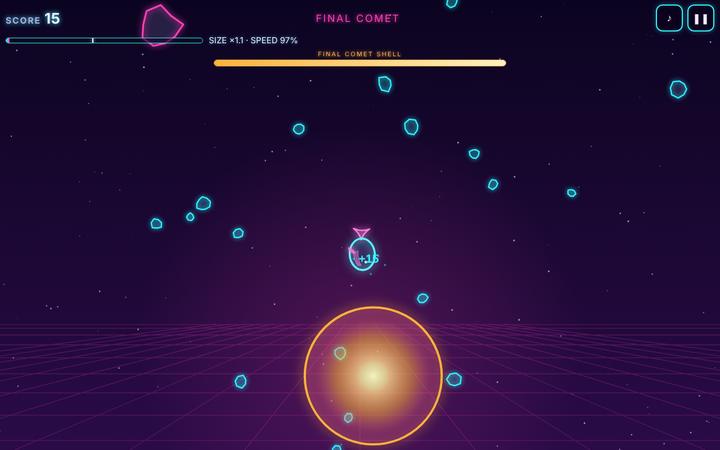
- A space whale swims through an asteroid field eating smaller rocks to grow. Bigger means slower and a bigger target, so you have to choose when to grow. Every few waves a giant comet boss charges through.
- The one thing it had to have
- growing bigger makes you slower and easier to hit
- How they chose to work
- Check-ins: Autopilot · Just build it
- Where their calls changed the game
- Autopilot: she approved the design and let it build to the end. She asked for breathers after each comet and a separate thumb button for spitting on phones.
Below are the actual documents from the build, unedited: the AI's messages, its plan and its replies. The person's answers were written by us for this demo, the way a real buyer would answer.
The check-insWhere they approved the plan, playtested, and asked for changes
Check-in mode: Autopilot, so the only stop is design approval (required in every mode).
Checkpoint 1: Design approval
Agent
I've written the one-page design in GAME_DESIGN.md (shown in full in chat). It has five open choices for you, each with my recommendation marked ★: how you choose when to grow, what a hit does, how you beat the Final Comet, art direction, and the difficulty curve.
Approve this, change anything, or pick from the options above. I won't write game code until you say go.
What I need from you: "go" (I'll use the ★ picks), or your picks and changes. What happens next: on Autopilot I build, test and polish straight through to hand-off without stopping again.
Designer
go. You read the run correctly (losing ends it early, beating the Final Comet is the win).
Picks: 1A, 2A, 3A, 4A, 5B (I want breathers after each comet, to regroup and decide whether to grow).
One change: on phone, dragging and tapping to spit will fight each other. Give spitting its own big thumb button in the bottom corner, and keep dragging for steering.
Autopilot from here.
Agent (follow-up)
Approved and logged. Building with 1A shed on demand, 2A lose mass on hit, 3A crack the Final Comet's shell then eat its core, 4A glow lines, and 5B steady ramp with a calm breather wave after each comet. On phone, spitting gets its own big thumb button in the bottom-right corner and dragging stays for steering only (touches that start on the button never steer). Autopilot: no more stops until hand-off.
No further checkpoints
Autopilot was chosen, so there was no first-playable playtest stop. The three playtest questions are in the README's playtest checklist. The build was tested, tuned and handed off without stopping.
The plan they approvedThe one-page design, with the options they picked from
Designed by Priya R. · Built with Claude Code · 2D · Fair · ~3 min run
Pitch
You are a space whale. You steer through an asteroid field eating smaller rocks to grow big enough to beat the final comet boss. You lose when a rock or comet bigger than you hits you while you're already at your smallest.
Core loop (10 seconds)
Spot a cluster of glowing rocks smaller than you, swoop through it, gulp them (a pop, a chime, a little size bump), then swerve away from the pink-outlined rocks that are bigger than you. Every gulp makes you stronger but heavier, so each swoop is a small bet: is this snack worth getting slower and wider? That bet is the agar.io tension, and the neon pops and particles give it the Geometry Wars buzz.
Readable chaos: rocks you can eat glow cyan; rocks that can hurt you glow pink. The color flips live as you grow, so getting bigger visibly turns threats into food.
Controls
- Computer: the whale swims toward the mouse pointer (hold or just move). Keyboard alternative: WASD / arrow keys.
Mmutes,PorEscpauses. - Phone (one thumb): touch and drag anywhere; the whale swims toward your finger, offset slightly above it so your thumb never hides the whale. Large on-screen mute and pause buttons in the corners (at least 48px).
A run
- Start (0:00–0:45): small whale, slow sparse field, mostly cyan snacks. Learn to steer and eat.
- Rise (0:45–2:20): waves get denser and faster; more big pink rocks drift in. Comet bosses charge through after waves 3 and 6: a warning streak shows the lane, then the comet crosses the screen.
- End (~2:30–3:00): the Final Comet arrives and makes several passes. Beat it to win. Get hit at minimum size at any point and the run ends with your score.
- Score: points for every rock eaten (more for bigger ones), a bonus for each comet survived, a big bonus for beating the Final Comet. Best score shown for this session only.
Progression (5 beats in one run)
- First gulp: the whale grows visibly and you feel the first bit of slowdown.
- The color flip: a rock that was pink turns cyan because you outgrew it.
- Comet #1 (after wave 3): a warning line, then a fast charge you must dodge. Being big makes this scary.
- Comet #2 (after wave 6): faster, and it sprays rock debris in its wake.
- Final Comet: the boss fight and the win.
Must have: growing bigger makes you slower and easier to hit
This drives every number in the game. Size directly sets top speed and turn rate (bigger = slower to change direction) and hitbox (your drawn body is your hitbox, so bigger is honestly easier to hit). A size meter in the HUD shows current size next to a speed readout, so the trade-off is never hidden.
Your choices (pick one per line; ★ = my recommendation)
1. How you "choose when to grow"
- A ★ Shed on demand: you grow automatically when you eat, but you can tap/press Space to spit out mass as a fast cyan shot. Shrinking makes you quicker and smaller; the shot can also hit things. Grow and shrink is always your choice.
- B Belly then digest: eaten rocks fill a belly meter; you only grow when you press "digest". Clear choice, but a second resource to watch.
- C Auto-grow only: pure agar.io. The only choice is which rocks to eat or avoid.
2. What happens when something bigger hits you
- A ★ Lose mass: a hit knocks off a chunk of size (with a short flash of invulnerability). At minimum size, the next hit ends the run. Getting hit makes you smaller and faster, which is a nice comeback rhythm.
- B Three hearts: any hit costs a heart regardless of size.
3. How you beat the Final Comet
- A ★ Crack its shell, then eat its core: dodge its charges and land spit shots (or ram it when you're big enough) to crack it; once cracked its glowing core is edible. Needs choice 1A to work as written.
- B Size check: be above a target size when it arrives, then ram it. Simple, but the fight is decided before it starts.
- C Survive: outlast five passes. Easiest to build, least satisfying.
4. Art direction (all neon outlines on dark purple, no textures)
- A ★ Glow lines: thin pink/cyan outlines with soft bloom, a faint retro grid horizon, slow parallax stars.
- B Filled neon: solid gradient shapes with bright rims. Busier, a little less "synthwave".
5. Difficulty curve (Fair)
- A ★ Steady ramp: density and speed rise each wave; a fair player reaches the Final Comet in about 2.5 min on the first or second try and beats it in a few tries.
- B Breathers: a calm wave after each comet to regroup and grow.
Scope cut list (not in this prototype)
- Menus, upgrades, unlocks, saved progress: no storage, and no shop or currency (you asked to avoid ad-game feel; nothing pops up mid-run).
- Multiple whale types or skins: one whale proves the idea.
- Other enemy types (hunters, black holes, mines): rocks and comets are enough to test grow-versus-risk.
- Levels or a map: one endless-feeling field that scales by wave.
- Online leaderboard: offline only, best score per session.
- Composed music: a short generated synth loop, not a full soundtrack.
What success looks like
- You catch yourself hesitating over a juicy rock because you know it'll make you slower for the next comet.
- Shrinking yourself on purpose to dodge feels clever, not like a penalty.
- Beating the Final Comet feels earned, and losing makes you want one more run right away.
Approve this, change anything, or pick from the options above. I won't write game code until you say go.
The interviewThe three batches of questions and their answers
The full intake exchange between Game Prototype Builder (the agent) and the designer, in order.
Agent
Hi, and welcome! I'm Game Prototype Builder. I'll turn the game in your head into a first playable prototype you can open, play and share, usually in one sitting.
Here's how it works:
- Intake: a short interview in three batches.
- Design: a one-page plan you approve.
- Build: I write and test the game.
- Playtest: you play it and tell me what felt off.
- Polish and hand-off: I finish it and hand it over with everything you need to keep going.
You stay in control the whole way: you're the designer, I'm the builder. A first build usually takes 30 to 90 minutes of my work (more for 3D).
Batch A: You
- What should the game's credits say? ("Designed by ___": a name, a handle, or a studio.)
- Your experience: Never made a game / Tinkered or followed tutorials / Started games but never finished one / Shipped something small / Professional.
- Can you read code? None / A little / Comfortably.
- What is this prototype for? Test whether an idea is fun / Show friends or family / Pitch it to someone / The start of a real game I'll build properly / A gift / Just to learn how games are made.
- Where will you playtest it? Phone / Computer / Both.
Designer
- Priya R.
- Shipped something small (a jam game in Godot)
- Comfortably
- Test whether an idea is fun
- Both
Agent
Thanks, Priya. A shipped jam game is a great starting point: you know what "small enough to finish" feels like, so I'll respect your scope and only push back if something can't be built and tested well today.
Batch B: The game
- The idea, in your own words. One to three sentences is plenty.
- 2D or 3D? (Or "you decide". 2D is faster and more reliable for a first prototype; 3D works but takes longer and looks rougher.)
- The core action: what does the player do over and over? (Jump, steer, match, build, aim, serve, dodge…)
- The one thing it must have. The part that makes it your idea. This is never cut.
- Games it should feel like, and what to take from each. Feel and ideas only; never their art, characters or names.
- Look and mood: colors, style, era, vibe. A few words is enough.
- How a run should end: a clear win, a high-score run that ends when you lose, or endless. Roughly how long should one run be? (2 to 5 minutes works best for a prototype.)
- Anything to avoid: themes, mechanics, difficulty, things that would spoil it for you or your audience.
Designer
- A space whale swims through an asteroid field eating smaller rocks to grow. Bigger means slower and a bigger target, so you have to choose when to grow. Every few waves a giant comet boss charges through.
- 2D
- Steer and eat
- Growing bigger makes you slower and easier to hit
- agar.io's grow-and-risk tension; Geometry Wars' glowy neon chaos (but readable, not overwhelming)
- Neon synthwave, dark purple space, glowing pink and cyan outlines
- Score run that ends when you lose, ~3 minutes, with a final boss you can beat
- Anything that feels like a mobile ad game (no fake currency, no popups)
Agent
Love it. The grow-versus-risk trade is a clear, testable question, which is exactly what a prototype is for. Last batch.
Batch C: How we work
- How often should I check in with you?
- Autopilot: you approve the design, then I build, test and polish without stopping. Fastest.
- Standard (recommended): you approve the design, then you play the first playable build and tell me what felt off before I polish.
- Hands-on: Standard, plus a quick look after every milestone (core loop, progression, juice) so you steer as it grows.
- How much explanation do you want?
- Just build it: short updates, no lectures.
- Explain my calls: when I decide something, I tell you why in a sentence or two.
- Teach me as we go: after each system is built, I explain how it works in plain language and point you to the exact file and function.
- Difficulty: Gentle (most people win) / Fair (a few tries) / Tough (for people who like a challenge).
- A short name for the project folder and the game's working title. (Or "you decide".)
Designer
- Autopilot
- Just build it
- Fair
- You decide
Agent
Got it. You delegated the title, so I picked Starwhale as the working title and starwhale as the folder name (short, says what you play, easy to change later; it's listed under "Your calls").
One note on question 12: you asked for a score run that ends when you lose and a final boss you can beat. I've read that as: your score builds the whole run, losing ends it early, and beating the final boss at around the 3-minute mark is the win. Tell me if you meant it differently.
🎮 PROTOTYPE PROFILE
Title: Starwhale (working title, my call)      Designed by: Priya R.
Idea: A space whale swims through an asteroid field eating smaller rocks to grow.
      Bigger means slower and a bigger target, so you have to choose when to grow.
      Every few waves a giant comet boss charges through.
View: 2D   Core action: steer and eat   Must have: growing bigger makes you slower and easier to hit
Feels like: agar.io's grow-and-risk tension; Geometry Wars' glowy neon chaos (readable, not overwhelming)
Look & mood: neon synthwave, dark purple space, glowing pink and cyan outlines
Run: score run that ends when you lose, plus a beatable final boss as the win, ~3 min
Avoid: anything that feels like a mobile ad game (no fake currency, no popups)
Playtest on: Both (phone and computer)   Purpose: Test whether an idea is fun
Experience: Shipped something small (Godot jam game)   Reads code: Comfortably
Check-ins: Autopilot   Explanations: Just build it   Difficulty: Fair

Lock this in?
Designer
Yes.
Profile locked. Next step: the one-page design in GAME_DESIGN.md, for approval before any game code is written.
Make your own
Describe the game you've always wanted to make. Claude Code interviews you, writes a plan you approve, builds it, tests it, and asks you to playtest before it polishes. You make every creative call.