Snail Mail
Designed by Theo, started games but never finished one. Built by Claude Code with the Game Prototype Builder prompt.
- The idea, in their words
- A snail courier delivering letters across a garden. The snail is slow but sticks to any surface, walls and ceilings included, so the levels are about finding routes up and over things. Birds swoop when you're out in the open.
- The one thing it had to have
- crawl on walls and ceilings, and the camera stays readable upside down
- How they chose to work
- Check-ins: Standard · Just build it
- Where their calls changed the game
- He'd never finished a game, so the AI proposed one garden of five rooms and named everything it cut. He added a ladybug who says thank you for the first letter, and asked for a bigger snail at the playtest.
Below are the actual documents from the build, unedited: the AI's messages, its plan and its replies. The person's answers were written by us for this demo, the way a real buyer would answer.
The check-insWhere they approved the plan, playtested, and asked for changes
Every stop where the agent waited for Theo, with the question and the reply.
Checkpoint 1: Design approval
Agent: I've written the one-page design in GAME_DESIGN.md. Because you've started games before but not finished one, I scoped it to one garden of 5 short rooms with one letter each. There are six choices in it (what birds do, how they warn you, hiding, snail speed, art direction, room flow), each with my recommendation marked. Approve this, change anything, or pick from the options above. I won't write game code until you say go.
Theo: OK on the scope. Five rooms is perfect. And yes, keep the name Snail Mail.
Picks: 1A, 2A, 3A, 4A, 5A, 6A.
One change: at the very start of room 1, let me deliver one letter to a tiny ladybug who says "thank you!" in a speech bubble. I want the first delivery to feel like it matters.
Log this in CHECKPOINTS.md and build.
Agent: Approved with your picks: birds snatch your letter and drop it back where you found it (1A), a growing shadow and a chirp warn you about 2 seconds ahead (2A), leaf cover plus a shell button (3A), slow crawl with a slime-glide boost (4A), a watercolor storybook look (5A), and separate short rooms (6A). Your change is in: room 1 opens with the snail already carrying a letter for a tiny ladybug a few steps away. When you reach her, she says "thank you!" in a speech bubble before the room's main letter. That makes 6 letters in total. Building now.
Checkpoint 2: First-playable playtest
Agent: The first playable build of Snail Mail is ready: dist/snail-mail.html. Double-click it to open it in your browser. It works offline, on a computer or a phone.
My automated tests passed at desktop size (1280x800) and phone size (390x844 with touch). The bot started from the real Play button, delivered all 6 letters, reached the end screen and pressed Play Again. It recorded no console errors and no network requests, and it also completed one full run with the network off. A bot can tell me the game works, but not whether it's fun. That's your job.
Please play for two or three minutes, then tell me:
- What felt good?
- What felt off or confusing?
- If you could change one thing, what would it be?
Your answers become the top priority for the progression-and-polish pass.
Theo: (played on laptop, then phone)
- What felt good: crawling up the pot and across the bench felt great, and the ladybug "thank you!" is exactly the start I wanted. The watercolor look is lovely.
- What felt off:
- The snail is tiny. On my laptop it's a little speck in a big room, and on my phone I lost it against the flower. When I'm upside down I can't really tell it's upside down, because it's too small to read.
- The bird's warning shadow is hard to see on the grass.
- The rooms feel a bit empty for a "storybook garden".
- The one change: zoom the camera in so the snail is clearly the hero (2 to 3 times bigger on screen), with its shell, eyes and letter readable at any angle.
Also: make the bird shadow a dark, growing ellipse with a ring, add more garden life (extra flowers, pebbles, a watering can, a garden gnome in the background), and keep the room-name hint short on phones.
Log this in CHECKPOINTS.md, then polish and hand off.
Agent: Thanks, Theo, that's clear feedback, and the snail size is my miss. Doing all of it now:
- The camera zooms in and the snail is drawn bigger, about 2.3 times its old size on screen. It gets a soft light halo and a bolder outline so it stands out against flowers, and its eyes and letter scale up with it.
- The bird shadow becomes a dark ellipse that grows to fill a ring marking where the bird will land.
- Each room gets extra flowers, pebbles, a watering can and a garden gnome in the background.
- Phones get short room hints.
One trade-off, in a sentence: zooming in means you see less of the room, which makes spotting a route harder. To keep that part of your idea, each room opens zoomed out for a moment, then glides in to the snail. I'll list that under "Your calls" so you can turn it off.
The plan they approvedThe one-page design, with the options they picked from
Designed by Theo · Built with Claude Code
A note on scope first. You told me you've started games but never finished one. The pattern that sinks solo projects is starting at full size, so I'm proposing we prototype just one garden of 5 short rooms, one letter per room, and leave a world map, more biomes, a story and extra snail abilities for later. That's enough to answer the only question that matters today: is crawling over everything fun? OK?
Pitch
You are a snail courier. You crawl up walls, across ceilings and over giant flowers to deliver every letter in the garden. You never die: when a bird catches you out in the open, it snatches your letter and you crawl back to collect it again.
Core loop (the 10-second action)
Look at the room, spot a route ("up the pot, across the underside of the bench, down the fence"), then crawl it. The good feeling: corners wrap smoothly, the snail sticks with a satisfying little squish, and going upside down feels like a superpower, not a confusion. Slow movement is the point, so every surface you cross should feel like progress, marked by a shiny slime trail behind you.
Controls
- Computer: Arrow keys or WASD: push the direction you want to go on screen. The snail follows the surface it's on and wraps around corners on its own. Space = tuck into shell (hide). Down while on a ceiling = let go and drop.
- Phone (one thumb or two): a big on-screen joystick on the left half, a big shell button on the right. The joystick works the same as the arrow keys. Touch targets at least 64px.
A run (target: 3 to 4 minutes)
- Start: title screen, big Play button, one sentence of story ("The garden's mail won't deliver itself.").
- Rise: 5 rooms, about 35 to 50 seconds each. Pick up the letter, carry it to the room's mailbox, the next room slides in.
- End: the last letter lands in the big mailbox at the top of the old oak. End screen shows your time, letters snatched, and best time this session, plus Play Again.
Progression (5 beats in one run)
- The Flowerbed: flat ground, one tall pot. Learn to climb a wall.
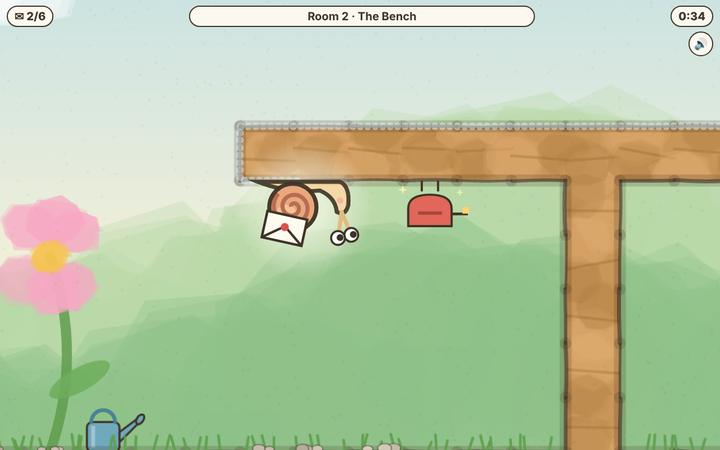
- The Bench: the mailbox hangs under a bench. Learn ceilings.
- The Open Lawn: first bird. Its shadow grows for about 2 seconds before it swoops. Learn to hide under leaves or in your shell.
- The Trellis: a vertical maze of vines and big flowers, two birds, several routes.
- The Old Oak: a tall final climb, mostly upside down under branches, with leafy cover spots to rest in.
Must have: walls, ceilings and a readable camera upside down
- The snail sticks to every solid surface: floors, walls, ceilings, and the outside corners between them.
- The world never rotates. The garden always stays the right way up; only the snail flips. Its shell, eyes and the letter it carries are drawn so you can always tell which way it faces.
- The camera follows smoothly with a little look-ahead in the direction you're crawling, so you can see where a ceiling route leads.
- Controls are screen-relative, so "right" always means right on screen, even upside down.
Your choices (pick one per line, or say "go with your picks")
- What a bird does when it catches you
- A. Snatches your letter and drops it back where you found it. You crawl back. (recommended: a real cost, no death, fits "gentle")
- B. Knocks you back to the last flower you passed, letter kept.
- C. Just a "scared" stun for 2 seconds, no setback.
- How birds warn you
- A. A growing shadow plus a chirp, about 2 seconds before the swoop. (recommended: no fast reflexes needed)
- B. Birds fly fixed, visible patrol loops you can time.
- Hiding
- A. Leaf cover spots and a shell button you can use anywhere (you can't move while hiding). (recommended)
- B. Leaf cover only, no shell button (more route-planning, slightly harder).
- Snail speed
- A. Slow and steady, with a short "slime glide" boost when you hold the direction for 1 second. (recommended: slow but not tedious)
- B. One constant slow speed.
- Art direction
- A. Soft watercolor look: blotchy painted backdrops, wobbly ink outlines, paper grain. (recommended: matches "storybook")
- B. Clean flat pastel shapes, no texture (crisper on small phones).
- Room flow
- A. Separate short rooms, Super Meat Boy style, one letter each. (recommended: matches your reference)
- B. One connected garden you scroll through.
Scope cut list (not in this prototype)
- World map, more gardens, unlockable rooms: one garden proves the idea.
- Story, characters you deliver to, dialogue: charm later; the crawl must be fun first.
- Extra abilities (jumping, slime bridges, speed shells): they'd change the core before we know if it works.
- Saving progress, settings menu, leaderboards: a session best time is enough for now.
- Hand-made art or music files: everything is drawn and played in code so it stays one offline file.
What success looks like
- Going upside down on a ceiling makes you grin, and you never lose track of which way is up.
- Looking at a new room, you think "ooh, I bet I can go that way," and you're right.
- Birds make the open lawn feel tense but never unfair, and you finish all 5 letters in about 3 to 4 minutes.
Approve this, change anything, or pick from the options above. I won't write game code until you say go.
The interviewThe three batches of questions and their answers
The conversation between Game Prototype Builder (the agent) and Theo (the designer), in order.
Agent
Hi Theo, welcome! I'm Game Prototype Builder, and I'm here to turn the game in your head into something you can actually play today.
Here's how this works:
- Intake: a short interview in three batches.
- Design: a one-page plan you approve.
- Build: I write and test the game.
- Playtest: you play it and tell me what felt off.
- Polish and hand-off: I finish it and hand it over with everything you need to keep going.
You stay in control the whole way: you're the designer, I'm the builder. A first build usually takes 30 to 90 minutes of my work (more for 3D).
Batch A: You
- What should the game's credits say? ("Designed by ___": a name, a handle, or a studio.)
- Your experience: Never made a game / Tinkered or followed tutorials / Started games but never finished one / Shipped something small / Professional.
- Can you read code? None / A little / Comfortably.
- What is this prototype for? Test whether an idea is fun / Show friends or family / Pitch it to someone / The start of a real game I'll build properly / A gift / Just to learn how games are made.
- Where will you playtest it? Phone / Computer / Both.
Theo
- Theo
- Started games but never finished one
- None
- Test whether an idea is fun
- Both
Agent
Thanks, Theo. Testing whether an idea is fun is exactly what a prototype is for, so we'll keep it tight. Now the fun part.
Batch B: The game
- The idea, in your own words. One to three sentences is plenty.
- 2D or 3D? (Or "you decide". 2D is faster and more reliable for a first prototype; 3D works but takes longer and looks rougher.)
- The core action: what does the player do over and over? (Jump, steer, match, build, aim, serve, dodge…)
- The one thing it must have. The part that makes it your idea. This is never cut.
- Games it should feel like, and what to take from each. Feel and ideas only; never their art, characters or names.
- Look and mood: colors, style, era, vibe. A few words is enough.
- How a run should end: a clear win, a high-score run that ends when you lose, or endless. Roughly how long should one run be? (2 to 5 minutes works best for a prototype.)
- Anything to avoid: themes, mechanics, difficulty, things that would spoil it for you or your audience.
Theo
- A snail courier delivering letters across a garden. The snail is slow but sticks to any surface, walls and ceilings included, so the levels are about finding routes up and over things. Birds swoop at you when you're out in the open.
- 2D
- Crawl and stick to surfaces
- You can crawl on walls and ceilings, and the camera stays readable when you're upside down
- A gentler Super Meat Boy level structure without the dying; the cozy charm of A Short Hike
- Sunny storybook garden, watercolor greens, big flowers
- A clear win (deliver all letters), about 3-4 minutes
- Avoid needing fast reflexes
Agent
A snail courier who can walk on the ceiling: I love that. The route-finding angle gives it a real puzzle heart without needing quick hands. Last batch, about how we'll work together.
Batch C: How we work
- How often should I check in with you?
- Autopilot: you approve the design, then I build, test and polish without stopping. Fastest.
- Standard (recommended): you approve the design, then you play the first playable build and tell me what felt off before I polish.
- Hands-on: Standard, plus a quick look after every milestone (core loop, progression, juice) so you steer as it grows.
- How much explanation do you want?
- Just build it: short updates, no lectures.
- Explain my calls: when I decide something, I tell you why in a sentence or two.
- Teach me as we go: after each system is built, I explain how it works in plain language and point you to the exact file and function, plus one small optional change to try yourself.
- Difficulty: Gentle (most people win) / Fair (a few tries) / Tough (for people who like a challenge).
- A short name for the project folder and the game's working title. (Or "you decide".)
Theo
- Standard
- Just build it
- Gentle
- You decide
Agent
Got it. You left the title to me, so I'm calling it Snail Mail (folder: snail-mail). It says what the game is in two words, and it's easy to change later. I'll list it under "Your calls."
Here's your profile:
🎮 PROTOTYPE PROFILE
Title: Snail Mail            Designed by: Theo
Idea: A snail courier delivers letters across a garden. Slow, but sticks to any
      surface (walls and ceilings too), so levels are about finding routes up and
      over things. Birds swoop when you're out in the open.
View: 2D   Core action: crawl and stick to surfaces
Must have: crawl on walls and ceilings, with the camera staying readable upside down
Feels like: a gentler Super Meat Boy level structure (no dying); the cozy charm of A Short Hike
Look & mood: sunny storybook garden, watercolor greens, big flowers   Run: win (deliver all letters), ~3-4 min
Avoid: needing fast reflexes
Playtest on: phone and computer   Purpose: test whether the idea is fun
Experience: started games but never finished one   Reads code: none
Check-ins: Standard   Explanations: Just build it   Difficulty: Gentle
Lock this in?
Theo
Yes.
Agent
Locked in. Next I'll write a one-page design for you to approve. No game code until you say go.
Make your own
Describe the game you've always wanted to make. Claude Code interviews you, writes a plan you approve, builds it, tests it, and asks you to playtest before it polishes. You make every creative call.