Paper Glider
Designed by Marcus Bell, three abandoned unity projects; the start of a real game. Built by Claude Code with the Game Prototype Builder prompt.
- The idea, in their words
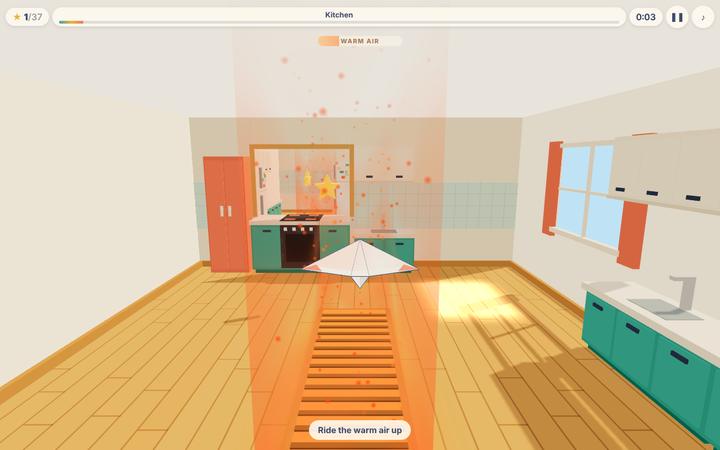
- You are a paper airplane gliding through a messy house. Thread through gaps between furniture, ride warm air from heater vents to climb, and collect stars from the kitchen to the attic.
- The one thing it had to have
- heater vents that lift the plane
- How they chose to work
- Check-ins: Standard · Explain my calls
- Where their calls changed the game
- He wanted a neighborhood, day and night, and upgrades. The AI named the pattern behind his abandoned projects and proposed one house instead. At the playtest he asked for vents and an attic window you can't miss.
Below are the actual documents from the build, unedited: the AI's messages, its plan and its replies. The person's answers were written by us for this demo, the way a real buyer would answer.
The check-insWhere they approved the plan, playtested, and asked for changes
Checkpoint 1: Design approval
Builder
I've written the one-page design in GAME_DESIGN.md (shown in full in chat). Please approve it, change anything, or pick from the six options in "Your choices" (camera, hitting furniture, touching the floor, what stars do, palette, difficulty curve). If you just say "go", I'll use my recommendations (★) and list them under "Your calls."
What I need from you: approval, changes, or option picks. What happens next: I build the core loop and a first playable run, test it, and come back for your playtest. I won't write game code until you say go.
Marcus
go. The vertical slice is the right call, and honestly that's why my last three projects died. Thanks for the production notes too.
Picks: 1A, 2A, 3A, 4A, 5A. For 6 I want C (gaps narrow and the plane gets slightly faster upstairs). I want the attic to feel like a finale.
One change: I'll share this link with friends who'll open it on their phones, so make the touch steering genuinely usable, not just present. Drag to bank and pitch is fine.
Log this in CHECKPOINTS.md and build.
Builder (response)
Got it. Locked picks: chase cam (1A), soft bounce on furniture (2A), soft landing and relaunch from the last vent (3A), stars as optional score with a lift puff (4A), warm cream / honey wood / coral-teal-mustard palette (5A), and gaps narrow with the plane getting slightly faster upstairs (6C), with the attic built as a finale.
Change accepted: phone touch steering moves from the cut list into scope. Drag anywhere to bank and pitch, from wherever your thumb first lands, with big readable on-screen feedback. I've updated GAME_DESIGN.md to match. Phone tuning is still a step down from computer tuning, since you're playtesting on a computer, but it will be tested at phone size with real touch input.
Checkpoint 2: First-playable playtest
Builder
The first playable is ready: a full run from the title screen, through the kitchen, living room, stairwell, upstairs hall, bedroom and attic hatch, out the attic window to the end screen, with Play Again.
How to open it: double-click dist/paper-glider.html. It's one file that works offline. To try it on your phone, send yourself the file, or drag it into Netlify Drop and open the link.
Self-test results (Playwright with Chrome; the bot flies with real key presses on desktop and real touch drags on the phone size):
| Size | Run finished | Run time | Landings | Play Again clean | Console errors | Network requests | Frame rate here |
|---|---|---|---|---|---|---|---|
| 1280×800 keyboard | yes | 1:43 | 0 | yes | 0 | 0 | 3.4 fps |
| 390×844 touch | yes | 1:44 | 0 | yes | 0 | 0 | 7.7 fps |
| 1280×800, network off | yes | 1:44 | 0 | yes | 0 | 0 | 2.5 fps |
The frame rates are from this test machine, which has software rendering (no GPU), 2 cores and other builds running alongside. They say nothing about your computer or phone, and I haven't measured those. The full runs used the test hook to speed up time.
Balance: the headless balance check (same physics, bots with human-like delay and wobble) gives a clean line of 1:40, "fair" players at 2:11 to 2:17 with 3 or 4 landings, and a sloppy player at 3:17. That puts a fair player in your 2-3 minute target. A bot can tell me the game works; it can't tell me whether it's fun. That's your job now.
Calls I made (Explain my calls):
- Touch pitch: dragging up means nose up (climb), the opposite of W on the keyboard. Most phone players expect "up means up". The keyboard keeps the approved W = dive. You can flip either with
invertTouchPitch/invertKeyboardPitchinsrc/tuning.js. - Floating stick: if your thumb drags past the edge of the ring, the ring follows it, so reversing direction is quick. Phones that support it give a short buzz on bumps.
- 36 stars, a mix of easy ones on the natural line and harder ones off it. Upstairs and in the attic they sit on harder lines.
- Attic finale: the plane is 24% faster, the light gets brighter and the music steps up a key. Then the plane sails out the window into the sky before the end screen.
Rough edges I already know about: the attic walls are very orange and a bit flat; at the attic hatch the camera briefly sits under the bedroom ceiling while the plane climbs; the title backdrop is mostly cabinets. I'll fix these in the polish pass.
What I need from you: play for two or three minutes, on your computer and ideally on a friend's phone, then answer:
- What felt good?
- What felt off or confusing?
- If you could change one thing, what would it be?
What happens next: your answers become the top priority for the progression and polish pass. After that I write the README and log and hand it over.
Marcus
Playtest on a laptop, plus a friend on his phone. About 2:15 for me.
- What felt good: the glide feel and the never-die rule. I didn't get frustrated once. The floating touch stick worked for my friend, and "up means up" on touch was the right call.
- What felt off:
- My must-have is hard to see. The vents look like grey radiator grates on the floor. I had to read "WARM AIR" to know I was in one. They need to glow orange, with a visible column of rising warm air you can aim for from a distance.
- The rooms don't look like a house yet. The "kitchen" is a hallway with a bookshelf, and the attic is one big flat orange wall of boxes. I want each room recognizable at a glance: kitchen counters, a fridge and a table; a living room couch and lamp; a bedroom bed; attic beams and boxes with a bright window you can see from far away as the goal.
- The plane is a bit small, and it disappears against the light floor.
- The one change: make the vents and the attic window impossible to miss. Those two things are the whole game.
Fine to leave: the camera clipping at the hatch, if it's a quick fix. The title backdrop can just be the kitchen.
Log this in CHECKPOINTS.md, then do the polish pass and hand off.
Builder (response)
Thanks. That's clear and specific. The priorities for the polish pass, in your order:
- Vents impossible to miss: glowing orange grilles and a tall column of rising warm air that's visible from across the room (it isn't dimmed by distance haze).
- Attic window impossible to miss: a bright sunlit window with a halo, visible from the moment you enter the attic. The attic becomes beams and box piles you thread between, not a solid wall, so the window stays in view as the goal.
- Rooms you recognize at a glance: kitchen counters, stove, fridge and a table you can fly under; a living room couch, lamp, TV and plant; a bedroom bed, nightstand and wardrobe; attic beams, a sloped roof and boxes. The furniture walls become house walls with real furniture in front of them.
- Plane easier to see: bigger, with a dark outline, coral wing tips and a soft shadow on the floor under it so you can judge height.
- Quick fixes: the hatch camera (the ceiling opens earlier above the hatch vent) and a kitchen title backdrop.
I'll keep everything you liked (glide feel, never-die, the touch stick) untouched, and re-run the balance and play-tests afterwards.
The plan they approvedThe one-page design, with the options they picked from
Designed by Marcus Bell · Built with Claude Code
Pitch
You are a paper airplane. You glide and steer through a messy house, riding warm air from heater vents to climb from the kitchen to the attic window. You never die: bumping furniture or touching down costs you time and height, not the run.
Core loop (the 10 seconds you repeat)
Glide forward and slowly sink → spot the next gap between furniture → steer through it → find the shimmer of a heater vent → ride the warm column up → pick the next line. It should feel good because the plane is always moving and always a little bit falling: every vent is a breath of relief, every gap you thread is a small "yes" (Flappy Bird's gaps), and nothing slams the brakes on the flow (Alto's calm).
Controls (Computer)
- Steer: A / D or ← / → bank left and right.
- Pitch: W / S or ↑ / ↓ nose down (dive, gain speed) and nose up (slow, float).
- Mouse option: hold the left mouse button and move to steer (shown on the title screen).
- M mute, P / Esc pause. Big Play button on the title screen.
Controls (Phone, added at approval)
- Drag anywhere to fly: put a thumb down anywhere and drag. Left/right banks, up/down pitches, measured from where your thumb first landed (a floating stick, drawn on screen as a soft ring). Let go and the plane levels out.
- Big mute and pause buttons in the top corners. Works portrait and landscape.
A run (target 2 to 3 minutes)
- Kitchen (start, ~30s): launched off the counter. Wide gaps (between chairs, under the table), one vent to teach lifting.
- Living room (~40s): couch, bookshelves, a lamp. Gaps narrow; two vents in a row to chain.
- Stairwell (~30s): a tall shaft. A stack of vents carries you up to the second floor; you have to stay in the warm column.
- Upstairs hall and bedroom (~40s): clutter, a ceiling fan, a doorway gap. Stars placed on harder lines.
- Attic (finish): one last big vent up through the hatch, then glide out the attic window. End screen: time, stars collected, best this session, Play Again.
Progression (beats you'll feel in one run)
- First vent: "oh, I can climb."
- Chaining vents in the living room: the first time you string two lifts together.
- The stairwell climb: a vertical moment after flying mostly forward.
- Tighter gaps + a ceiling fan upstairs that pushes you around (no damage).
- The attic window: daylight pouring in, a clear finish line.
Must have: heater vents that lift the plane
Vents are floor grilles with a visible warm shimmer (rising particles and a soft orange glow) and a gentle whoosh sound. Inside the column, the plane rises smoothly; the lift is strongest near the vent and fades with height, so you learn to ride it, not just touch it. They are the only way to climb, so the whole route is built around them. This is never cut.
Your choices (pick one per line; ★ = my recommendation)
- Camera: ★ A) chase cam just behind and above the plane, smoothly following · B) higher three-quarter view that shows more of the room · C) side-on view (more like Flappy Bird, less 3D).
- Hitting furniture: ★ A) soft bounce plus a small loss of speed and height · B) the plane crumples and respawns at the last vent after 1 second · C) a 3-crease meter; third crease respawns you at the last vent.
- Touching the floor: ★ A) soft landing, then the plane relaunches from the last vent you rode (about a 3 second cost) · B) you can "hop" off the floor once per room · C) you skid and slow down, then relaunch where you are.
- What stars do: ★ A) optional collectibles for score, each with a tiny lift puff · B) pure collectibles, no effect · C) you need a minimum number to open the attic window.
- Palette: ★ A) warm cream walls, honey wood, coral/teal/mustard toy furniture, golden sun beams · B) soft pastels (mint, peach, lavender) · C) saturated primary-color toy box.
- Difficulty curve (Fair): ★ A) gaps narrow and vents get further apart room by room · B) same spacing throughout, harder star placement only · C) gaps narrow and the plane gets slightly faster upstairs.
Approved picks
1A chase cam · 2A soft bounce · 3A soft landing + relaunch from last vent · 4A stars are optional score + lift puff · 5A warm cream / honey wood / coral-teal-mustard · 6C gaps narrow and the plane gets slightly faster upstairs; the attic is a finale. Touch steering must be genuinely usable for friends on phones.
Scope cut list (not in this prototype)
- The neighborhood: a whole new world to build; the house alone proves whether gliding is fun.
- Day/night cycle: lighting work that doesn't test the core loop; we use one warm afternoon.
- Paper upgrades: needs a meta-progression and many runs to balance; comes after the loop is fun.
- Multiple houses, saves, leaderboards, story.
Production notes (since this is the start of a real game)
The code is split into small modules (src/ for plane physics, vents, level layout, audio, UI) with one TUNING object. A production version would: build levels in an editor or data files rather than code, use real 3D models and baked lighting, use a proper physics/collision library, add a save system, and run in an engine like Godot or Unity if you need consoles.
What success looks like
- You feel the relief of catching a vent and want to chain the next one.
- You thread a gap you weren't sure you'd make, and it feels earned, not lucky.
- You reach the attic window in a few tries and want to beat your time or grab every star.
Approve this, change anything, or pick from the options above. I won't write game code until you say go.
The interviewThe three batches of questions and their answers
The full intake conversation, in order. The builder's messages are marked Builder, the designer's answers Marcus.
Builder
Hi! I'm Game Prototype Builder. I'll help you turn the game in your head into a first playable prototype you can open, play and share.
Here's how it works:
- Intake: a short interview in three batches.
- Design: a one-page plan you approve.
- Build: I write and test the game.
- Playtest: you play it and tell me what felt off.
- Polish and hand-off: I finish it and hand it over with everything you need to keep going.
You stay in control the whole way: you're the designer, I'm the builder. A first build usually takes 30 to 90 minutes of my work, a bit more for 3D.
Let's start with Batch A: You
- What should the game's credits say? ("Designed by ___": a name, a handle, or a studio.)
- Your experience: Never made a game / Tinkered or followed tutorials / Started games but never finished one / Shipped something small / Professional.
- Can you read code? None / A little / Comfortably.
- What is this prototype for? Test whether an idea is fun / Show friends or family / Pitch it to someone / The start of a real game I'll build properly / A gift / Just to learn how games are made.
- Where will you playtest it? Phone / Computer / Both.
Marcus
- Marcus Bell
- Started games but never finished one (three Unity projects, all abandoned)
- A little
- The start of a real game I'll build properly
- Computer
Builder
Thanks, Marcus. Three unfinished Unity projects is really common, and it's exactly what we'll design around: small, finishable, and clean enough to build on.
Batch B: The game
- The idea, in your own words. One to three sentences is plenty.
- 2D or 3D? (Or "you decide". 2D is faster and more reliable for a first prototype; 3D works but takes longer and looks rougher.)
- The core action: what does the player do over and over? (Jump, steer, match, build, aim, serve, dodge…)
- The one thing it must have. The part that makes it your idea. This is never cut.
- Games it should feel like, and what to take from each. Feel and ideas only, never their art, characters or names.
- Look and mood: colors, style, era, vibe. A few words is enough.
- How a run should end: a clear win, a high-score run that ends when you lose, or endless. Roughly how long should one run be? (2 to 5 minutes works best.)
- Anything to avoid: themes, mechanics, difficulty, things that would spoil it for you.
Marcus
- You are a paper airplane gliding through a messy house. Thread through gaps between furniture, ride warm air from heater vents to climb, and collect stars from the kitchen to the attic. Eventually I want a whole neighborhood, a day/night cycle and paper upgrades.
- 3D
- Glide and steer
- Heater vents that lift the plane
- The calm flow of Alto's Adventure, the gap-threading of Flappy Bird (but forgiving)
- Bright toy-like low-poly, soft shadows, warm afternoon sun
- A clear win (reach the attic window), about 2-3 minutes
- Frustrating instant deaths
Builder
Love it. A paper plane riding heater vents up through a house is a clear, ownable hook, and "calm, forgiving, no instant deaths" gives me a strong feel target.
Last one, Batch C: How we work
- How often should I check in with you?
- Autopilot: you approve the design, then I build, test and polish without stopping. Fastest.
- Standard (recommended): you approve the design, then you play the first playable build and tell me what felt off before I polish.
- Hands-on: Standard, plus a quick look after every milestone (core loop, progression, juice).
- How much explanation do you want?
- Just build it: short updates, no lectures.
- Explain my calls: when I decide something, I tell you why in a sentence or two.
- Teach me as we go: after each system, I explain how it works and give you one small optional change to try.
- Difficulty: Gentle (most people win) / Fair (a few tries) / Tough (for people who like a challenge).
- A short name for the project folder and the game's working title. (Or "you decide".)
Marcus
- Standard
- Explain my calls
- Fair
- Paper Glider
Builder
Here's your profile:
🎮 PROTOTYPE PROFILE
Title: Paper Glider            Designed by: Marcus Bell
Idea: You are a paper airplane gliding through a messy house. Thread through
      gaps between furniture, ride warm air from heater vents to climb, and
      collect stars from the kitchen to the attic. (Later: a whole
      neighborhood, a day/night cycle, paper upgrades.)
View: 3D   Core action: glide and steer   Must have: heater vents that lift the plane
Feels like: the calm flow of Alto's Adventure, the gap-threading of Flappy Bird (but forgiving)
Look & mood: bright toy-like low-poly, soft shadows, warm afternoon sun
Run: win (reach the attic window), ~2-3 min
Avoid: frustrating instant deaths
Playtest on: Computer   Purpose: The start of a real game I'll build properly
Experience: Started games but never finished one   Reads code: A little
Check-ins: Standard   Explanations: Explain my calls   Difficulty: Fair

Lock this in?
Marcus
Yes.
Builder
Locked in. One honest note before I write the design, because you told me you've started three games and never finished one:
The pattern that sinks solo projects is starting at full size. Your long-term idea (a whole neighborhood, a day/night cycle, paper upgrades) is a great destination, but it's three or four games' worth of work. So I'm proposing we prototype one vertical slice: a single house, kitchen to attic, in one 2-3 minute flight, and leave the neighborhood, day/night cycle and upgrades for later. That slice answers the only question that matters right now: is gliding and riding heater vents fun? If it is, everything else builds on top of it.
Because this is the start of a real game, I'll keep the code clean and organized so you can grow it, and I'll note what a production version would do differently.
Writing the one-page design now.
Make your own
Describe the game you've always wanted to make. Claude Code interviews you, writes a plan you approve, builds it, tests it, and asks you to playtest before it polishes. You make every creative call.